
Anime like Yasuke
If you loved Yasuke, these 12 shows share its strongest themes. Ranked by how closely their story, setting and tone match — with where to watch each one.
Swipe more like this → 1
Sengoku Basara: Samurai Kings
TV · 2009 · ★ 6.9
Why it's similar: both share Swordplay, Historical and Samurai.
Sengoku Basara drops you directly into the burning battlefields of feudal Japan, where rival warlords hack and slash their way to total domination. Each conqueror wields a special attack that boosts their powers of devastation, and each commands a horde of relentless warriors. But when a supreme evil - the Demon Lord - threatens the land, these fierce generals launch a co-op campaign of annihilation and build an army of armies to obliterate their common foe. As the front line grows crowded with gun-toting, mechanized samurai and mystical ninja, some will say that war is hell - but Sengoku Basara proves it can also be kick ass.
 2
Fire Emblem
OVA · 1996 · ★ 5.3
Why it's similar: both share Swordplay, Historical and War.
Prince Mars, heir to the throne of Aritia, has fled his homeland and the invaders bent on conquering the entire continent. Together with the Aritian Knights he hides and bides his time in the friendly island kingdom of Talus. Though criticized for constantly daydreaming or being in a bad mood, he has found a friend in Sheida, the princess of Talus. Together they indulge in hayrides and shopping trips, or just standing upon the parapet and looking out over the land. However, despite how pleasant life is, he cannot forget the circumstances that separated him from his land and forced his beloved sister to sacrifice herself for him.
 3
Shigurui: Death Frenzy
TV · 2007 · ★ 6.9
Why it's similar: both share Swordplay, Samurai and Historical.
Two damaged warriors wear the scars of a twisted and violent past. Bitter rivals for the secrets of their master's sword and the right to his daughter, these samurai inflict wounds on each other that would destroy lesser men. The final chapter of their saga unfolds within a brutal samurai tournament, a gruesome contest arranged to satisfy the bloodlust of a cruel tyrant overlord. The disfigured legends of the blade must summon the strength for one last battle - a final lesson in the artistry of violence where nothing is more beautiful than the kill.
 4
Biaoren
ONA · ★ 7.3
Why it's similar: both share Swordplay, Historical and Gore.
‘Escort’, refers to paid warriors, their targets of protection, are also referred to targets that are wanted by the government. On the eve of civil chaos during the last years of Sui dynasty, with the rise of a reign of terror around the country, various peoples’ feelings of grudge and animosity develop…
 5
Angolmois: Record of Mongol Invasion
TV · 2018 · ★ 6.7
Why it's similar: both share Samurai, Historical and War.
The traditional historical epic adventure centers around a samurai defending Japan against the first Mongol invasion of 1274.
 6
Time of Shura
TV · 2004 · ★ 7.2
Why it's similar: both share Swordplay, Samurai and Historical.
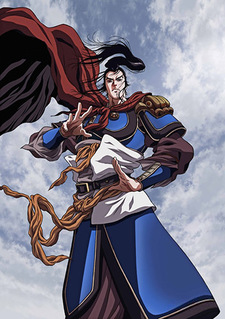
Legends tell of an invincible martial art known as Mutsu Enmei-Ryu, an unarmed style that allows the user to defeat any number of armed opponents using incredible speed and strength. This is the story of three generations of those who bear the name Mutsu, and their encounters and battles with the strongest fighters of their era.
 7
Beyond the Heavens
TV · 2009 · ★ 6.4
Why it's similar: both share Historical, Swordplay and Military.
Souten Kouro's story is based loosely on the events taking place in Three Kingdoms period of China during the life of the last Chancellor of the Eastern Han Dynasty, Cao Cao (155 – March 15, 220), who also serves as the main character. The Three Kingdoms period has been a popular theme in Japanese manga for decades, but Souten Kouro differs greatly from most of the others on several points. One significant difference is its highly positive portrayal of its main character, Cao Cao, who is traditionally the antagonist in not only Japanese manga, but also most novel versions of the Three Kingdoms period, including the original 14th century version, Romance of the Three Kingdoms by Luo Guanzhong. Another significant difference from others is that the storyline primarily uses the original historical account of the era, Records of Three Kingdoms by Chen Shou, as a reference rather than the aforementioned Romance of the Three Kingdoms novel. By this, the traditional hero of Romance of the Three Kingdoms, Liu Bei, takes on relatively less importance within the story and is portrayed in a less positive light. Yet, several aspects of the story are in fact based on the novel version, including the employment of its original characters such as Diao Chan, as well as anachronistic weapons such as Guan Yu's Green Dragon Crescent Blade and Zhang Fei's Viper Blade. A consistent theme throughout the story is Cao Cao's perpetual desire to break China and its people away from its old systems and ways of thinking and initiate a focus on pragmatism over empty ideals. This often puts him at odds with the prevalent customs and notions of Confucianism and those that support them.
 8
DRIFTERS
TV · 2016 · ★ 7.5
Why it's similar: both share Samurai, Swordplay and Historical.
The story centers around Shimazu Toyohisa, the real-life samurai who fought in the pivotal Battle of Sekigahara. In his dying moments, Shimazu is transported to a world of magic with other famous warriors throughout history. These warriors are forced to fight each other in an endless battle.
 9
Kingdom
TV · 2012 · ★ 7.4
Why it's similar: both share Swordplay, Historical and CGI.
When low-born servant boys Piao and Xin set out to become the world’s greatest war generals, they quickly find themselves caught up in a violent struggle between two noblemen plotting to overthrow the King. After Piao is killed protecting the rightful ruler of the kingdom of Qin, Xin sets out on a campaign for revenge that leads him straight into the fire of war. Now, with a target on his back and an army of enemies standing in his way, it will be up to a boy with no name and a young king without a throne to return order to their war-torn country in this historical action-drama based on the Tezuka Award-winning manga, Kingdom. Note: The first episode aired with a runtime of 50 minutes as opposed to the standard 25 minute runtime.
 10
Samurai 7
TV · 2004 · ★ 7.0
Why it's similar: both share Swordplay, Samurai and Historical.
In the far distant future, on a planet that might have been called "earth", there was a war between samurai who mechanized their bodies. After the long war, people enjoyed a modest peace. Facing starvation and abductions at the hands of fearsome mechanized bandits (Nobuseri), the farmers of Kanna Village make the dangerous choice to hire samurai for protection. The village's water priestess, Kirara, her younger sister, Komachi, and a heartbroken villager, Rikichi, set off to hire willing samurai with nothing to offer but rice from their meager harvests. Through dangerous encounters and a bit of luck, seven samurai of varying specialties and experience are gathered for an epic battle against the bandits and the merchants that influence them. Note: Samurai 7 is based loosely upon Kurosawa Akira's famous movie "Seven Samurai"/"Shichinin no Samurai".
 11
Rurouni Kenshin
TV · 1996 · ★ 7.9
Why it's similar: both share Swordplay, Samurai and Historical.
Himura Kenshin is a vagabond with a dark past and sunny disposition. Not a ronin but a rurouni, he was never a samurai, but an assassin of utmost skill in the Meiji restoration, who in the turning point of the war simply walked away. His travels lead him to Tokyo in the 11th year of the Meiji era, where he befriends a female Kendo master, a former thief, a brawler and a doctor all with their own secrets. Together they fight off the enemies surfacing from the dark past that Kenshin cannot escape.
 12
The Elusive Samurai
TV · 2024 · ★ 7.7
Why it's similar: both share Swordplay, Samurai and Historical.
In the year 1333, the Kamakura shogunate government comes crumbling down. A trusted vassal, Ashikaga Takauji, betrays the shogunate and organizes a rebellion. Houjou Tokiyuki, the rightful heir, escapes the massacre with a Shinto priest named Suwa Yorishige to Kamakura. On the run and fighting to stay alive, Tokiyuki sets in motion his plan to reclaim his birthright.


